
Have you ever woken up, rolled over in bed, and suddenly felt like the entire room was spinning out of control? If a simple head movement triggers a brief but intense sensation of spinning, you might be experiencing a common inner ear mechanical issue known as Benign Paroxysmal Positional Vertigo (BPPV).
BPPV is the most frequent cause of peripheral vertigo worldwide. Fortunately, because it is a mechanical issue, it responds exceptionally well to specialized physical treatments. Learn more about how our clinical team diagnoses these conditions by reviewing our balance testing and treatment services.
Quick Facts About BPPV:
- Benign: It is not life-threatening or progressive.
- Paroxysmal: It comes on in sudden, brief spells.
- Positional: It is strictly triggered by specific changes in head position.
- Vertigo: It creates a false sensation of spinning or whirling movement.
What are the Main Symptoms of BPPV?
The hallmark sign of BPPV is a sudden feeling that you or your surroundings are spinning. While the episodes are incredibly intense, they are usually very brief—typically lasting anywhere from a few seconds to just under two minutes.
Common symptoms experienced during a BPPV flare-up include:
- A true spinning sensation (vertigo)
- Lightheadedness or loss of balance
- Nausea, wooziness, or vomiting
- Mild instability that lingers after the spinning stops
Common Movement Triggers:
Because BPPV is directional, symptoms are almost always provoked by specific everyday head movements, such as:
- Rolling over or sitting up in bed
- Tipping your head backward to look up at a high shelf
- Bending over to tie your shoes or look down
- Making quick, sudden turns with your head
The Science of Sound and Balance: What Causes BPPV?
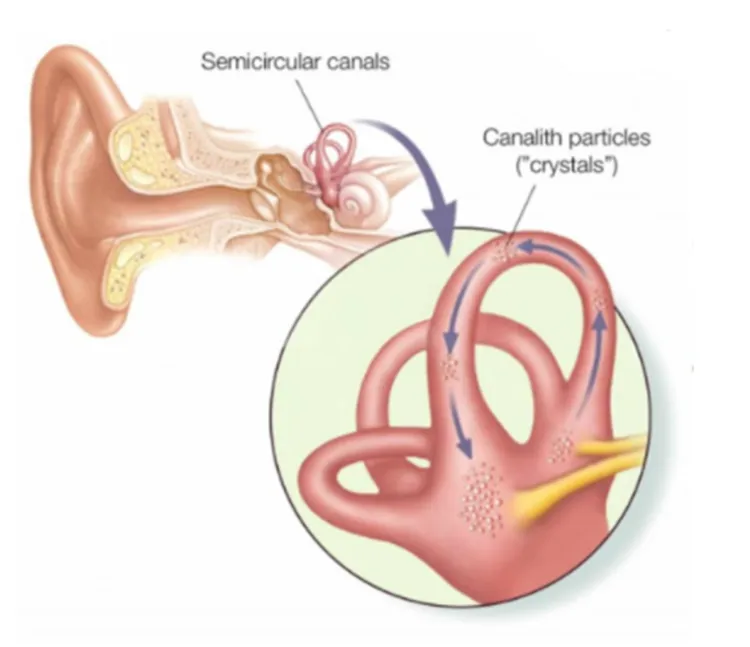
To understand how BPPV develops, it helps to explore the anatomy inside your inner ear balance organ. Deep within the ear sits the vestibular system, which serves as your body’s natural gyroscope. This system consists of two fluid-filled regions:
- The Otolith Organs (Utricle and Saccule): These structures contain microscopic gravity sensors made of tiny calcium carbonate crystals (otoconia).
- The Semicircular Canals: Three fluid-filled loops positioned at different angles to detect head rotations.
In a healthy system, these crystals stay securely embedded inside the otolith organs. However, due to natural age-related changes, minor head trauma, or inner ear inflammation, these tiny crystals can break loose.
When you move your head, gravity pulls these loose crystals into one of the semicircular canals where they don’t belong. As the crystals float through the canal, they displace the fluid inside it. This sends an incorrect, exaggerated movement signal to your brain. Because your eyes say you are sitting still but your inner ear says you are rapidly turning, your brain experiences a sensory mismatch, resulting in sudden vertigo.
Modern Treatment Options for Inner Ear Crystals
Because BPPV is a physical, mechanical problem rather than a biochemical disease, it cannot be cured with medications like motion sickness pills. Instead, it requires a mechanical solution to move the crystals back out of the balance canals.
- Canalith Repositioning Maneuvers (The Epley Maneuver): This is a highly effective, non-invasive treatment sequence. Your provider guides your head through a series of precise, slow angles. This uses the natural pull of gravity to roll the loose crystals step-by-step out of the semicircular canal and back into the main chamber where they can be harmlessly reabsorbed by the body. For many patients, the spinning completely resolves in just one or two sessions.
- Vestibular Rehabilitation Therapy (VRT): If a patient experiences lingering unsteadiness or mild dizziness after the crystals have been successfully cleared, targeted balance exercises can help retrain the pathways between the eyes, brain, and inner ear.
Frequently Asked Questions (FAQ)
Yes, in some instances, loose crystals will naturally float out of the canals or be reabsorbed by the body over several weeks or months. However, because specialized canalith maneuvers offer immediate, highly effective relief, patients can avoid weeks of unsteadiness by seeking a prompt evaluation.
No. Medications such as meclizine or over-the-counter motion sickness remedies only suppress the central nervous system to take the edge off the accompanying nausea. They do not move the physical crystals out of the balance canals and should not be used as a long-term solution.
BPPV can recur. Approximately 30% to 50% of individuals may experience another episode within a few years, especially if the underlying cause is related to age-related shifts or head trauma. If your symptoms return, they can be quickly managed using the same repositioning maneuvers.
Take the First Step Toward Ending the Spin
You do not have to live with the fear of unpredictable dizziness or the risk of structural falls. If you are experiencing sudden spells of vertigo, our specialized clinical team at Jacksonville Hearing & Balance Institute is here to help you regain your stability and peace of mind.